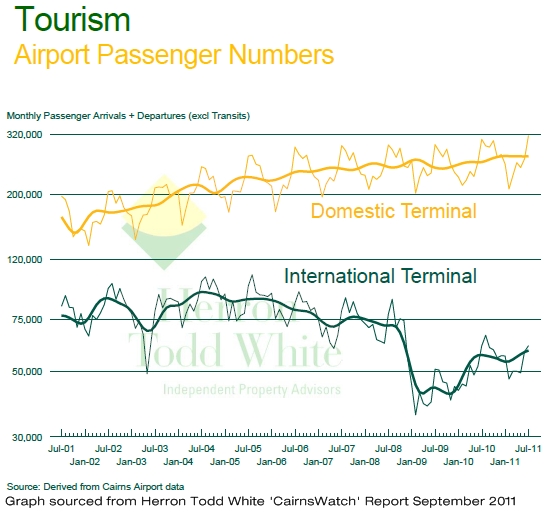
Most interesting are the personal accounts provided toward the end of the article by Cairns locals who assert that pronounced fluctuations in economic growth is just something that Cairns is used to, and that they are confident that the emerging Chinese tourist market will provide The Far North with its next much needed “boost”.

Perfect storms lash one-time tourist mecca
The Age - May 19th 2012
The Age - May 19th 2012
ALONG The Esplanade in Cairns, scores of tourism outlets
tussle grimly for passing trade. ''Hello!'' cry attendants to passing strangers
from the doorways of cafes and restaurants, their hopeful smiles fading as each
potential dollar moves on.
 |
| Click to Enlarge |
Tour companies and their agencies display racks of brochures
for countless struggling attractions spread across far north Queensland, each
one a survivor of the longest, most comprehensive slump ever to strike the
region. At night, while coach operators vie for backpackers to take on pub
crawls, restaurants with prices pared to the bone hire young women in short
dresses to stand on the footpath spruiking their menus and feigning interest in
the doings of tourists.
It's tough up here.
More than 400 small businesses and several large development
companies have gone to the wall since the slump began to bite in 2006-07.
Compounded by the closure of the Cairns-based Australian Airlines in 2007, as
well as the GFC, the Asian financial crisis, the high Australian dollar and the
natural disasters of 2010-11, the downturn became a locally focused recession
affecting every aspect of the economy.
Tourism, which returned $2.6 billion across the region in
2005-06, is now down by about $300 million, and Cairns (population 160,000) has
an unemployment rate of 9.8 per cent - among the nation's highest, and double
the state average. Despite promising signs of a recovery led by Chinese
tourists, the European, UK and US markets - once the bread and butter of local
tourism - remain mired in their own economic woes.
 ''China is the only growing market at the moment,'' says
Steve Davies (pictured), operations manager of Big Cat Green Island Cruises.
''Everything else is stagnant, shrinking, dead or going nowhere.''
''China is the only growing market at the moment,'' says
Steve Davies (pictured), operations manager of Big Cat Green Island Cruises.
''Everything else is stagnant, shrinking, dead or going nowhere.''
Bigger businesses such as Davies' have hung on by cutting
costs, reducing staff, delaying equipment upgrades and sharing boat space with
rival operators on days when there aren't enough passengers to make two cruises
viable. Other major companies have been forced to diversify, merge or chase
government tenders.
But small retailers, the so-called ''mum and dad''
operators, have been left with nowhere to hide. For veteran publican Gayle Scowcroft the crunch came last month,
when she was forced to call in a liquidator, cut her losses and close the doors
of Cairns' historic 114-year-old Cape York Hotel. Scowcroft's six-year battle
to make a go of it seems to bear testament to the reigning wisdom among local
hardheads. (''Tourism in Cairns has changed forever,'' asserts one real estate
agent. ''Forget sentiment; from now on only the lean and mean will survive.'')
 |
| Click to Enlarge |
But the popular and easy-going ex-publican, while admitting
she made mistakes, has a different take on the circumstances that left her ''on
the bones of my bum'' and $100,000 in debt. ''The whole thing made me realise
just how much our country is based on greed,'' says the one-time Toowoomba
school teacher who, with her late husband, Doug, had operated three other pubs
before she and her son Ben took over the Cape York in 2006.
By 2010, she says, three new supermarket-owned liquor
outlets (two Dan Murphys and a First Choice) had opened in Cairns, and her
drive-through bottle shop couldn't compete.
The worsening tourism slump, rising rents, electricity and
insurance costs added to her dilemma.
''I saw the writing on the wall, but I was pigheaded and a
bit proud and I just wouldn't give up,'' Scowcroft says.
''My landlord wouldn't negotiate on the rent … Then my
insurance went from $16,000 to $30,000, and they demanded the whole lot or I'd
be uninsured … that's when I knew I'd have to get out.'' Scowcroft says she
will stay in Cairns and try to find other work - ''perhaps on the political
side of things. I'd like to do something to help the place recover.''
Over the past few years the slump has also claimed three of
Cairns' largest construction/development tycoons: one-time plumber Tom Hedley
(whose Hedley Leisure and Gaming Property Fund was valued at $1.2 billion in 2008);
Roy Lavis (whose CEC Group collapsed last year with debts of almost $135
million); and Glencorp and Glenwood Homes owner Udo Jattke, who shut down his
30-year-old business last year owing $30 million.
 Gavin King, as a Cairns Post journalist, wrote about these
closures being part of a domino effect triggered by the tourism slump. He is
now the new Liberal National Party state member for Cairns (the first
conservative elected to the seat in more than a century) and says locals had
not realised how inexorably their fortunes were linked to tourism until the
''big three'' went under.
Gavin King, as a Cairns Post journalist, wrote about these
closures being part of a domino effect triggered by the tourism slump. He is
now the new Liberal National Party state member for Cairns (the first
conservative elected to the seat in more than a century) and says locals had
not realised how inexorably their fortunes were linked to tourism until the
''big three'' went under.
''In past slumps, like the pilots' strike [in 1989], and the
lull after 9/11, the big operators were able to hang on with ancillary
businesses,'' King told The Saturday Age. ''But this is much worse … these past
four to six years have been a really prolonged period of pain. A lot of
businesses are still on their knees. But there is an air of hope, particularly
in the situation with China, and the push for Cairns to get direct [tourism]
flights from that country.''
The Chinese market in Australia is potentially so big,
tourism operators haven't enough adjectives for the wonders they believe it
will unleash. But in Cairns - long vexed by the geographic isolation that
separates it from major tourism air routes - the word they invariably use is
''salvation''.
The obstacle in establishing direct flights from China is
that far north Queensland doesn't have the population to sustain return
flights. But Gavin King, flush with an $8 million ''attracting aviation fund''
from the state government, reckons he willl make direct flights a reality
within 12 months: ''The great example for how this could happen is Cathay
Pacific, which has been bringing Chinese tourists to Cairns from Hong Kong for
years, then returning with the bellies of their planes full of live local
seafood. We're confident we can achieve the same thing with direct flights from
China, returning with cargoes of seafood or agricultural products.''
Charles Woodward's CaPTA Group has been marketing its local
tourist attractions in China since 1997. Raised on a cane farm in what is now
part of Cairns' inner suburbs, Woodward was among a handful of entrepreneurs
who helped open the region to international tourism. With Jim Wallace, founder
and former owner of the Quicksilver Group (and now owner of Big Cat Green
Island Reef Cruises), and a few others, Woodward formed a ''marketing mafia''
and toured the world promoting his birthplace and the Great Barrier Reef.
He opened his famous RainForestStation Nature Park at
Kuranda in 1976, since bolstered by other nature-based attractions, including
the Cairns Wildlife Dome atop the Cairns Casino. ''Most of our tourists were
domestic until the Cairns International Airport opened in 1984,'' Woodward
says. ''After that, we had the real boom phase when all the airlines used to
run into Cairns [which ended after the pilots' strike] … then the Christopher
Skase white-shoe wankers phase. Next came the Japanese market boom in the early
'90s, which is when Daikyo came into Cairns and developed a lot of the major
hotel infrastructure.'' (With economic problems of their own, even before last
year's earthquake/tsunami, the Japanese no longer have a corporate presence in
far north Queensland.)
"...We're now heading into the Chinese phase... the moment we get direct flights, the Chinese market here will take off like it did in the Japanese boom..."
''We're now heading into the Chinese phase,'' he says
confidently. ''The moment we get direct flights, the Chinese market here will
take off like it did in the Japanese boom.''
Even without direct flights, 70,000 tourists from mainland
China are visiting Cairns annually, mostly via Melbourne, Sydney or Brisbane.
Thanks to his marketing legwork in China, 90 per cent of these arrivals
dutifully turn up at RainForestStation. ''When they started coming about 12
years ago it was all government-sponsored tours, so a lot of them were factory
managers and the like in Mao suits,'' he says. ''Now, as the country opens up,
we're getting the whole range - from very sophisticated to very
unsophisticated.''
Which sounds a bit like customer service in Cairns, where
larger tourism operations are already schooling their staff in the nuances of
being ''China-ready''.
View article source HERE
Peter Musso licensed real estate agent at Ray White Cairns Beaches selling property in Cairns' beautiful northern beach suburbs including Trinity Beach, Kewarra Beach, Clifton Beach, Palm Cove, Trinity Park, Smithfield, Yorkeys Knob, Holloways Beach, Machans Beach, Caravonica and surrounds.